

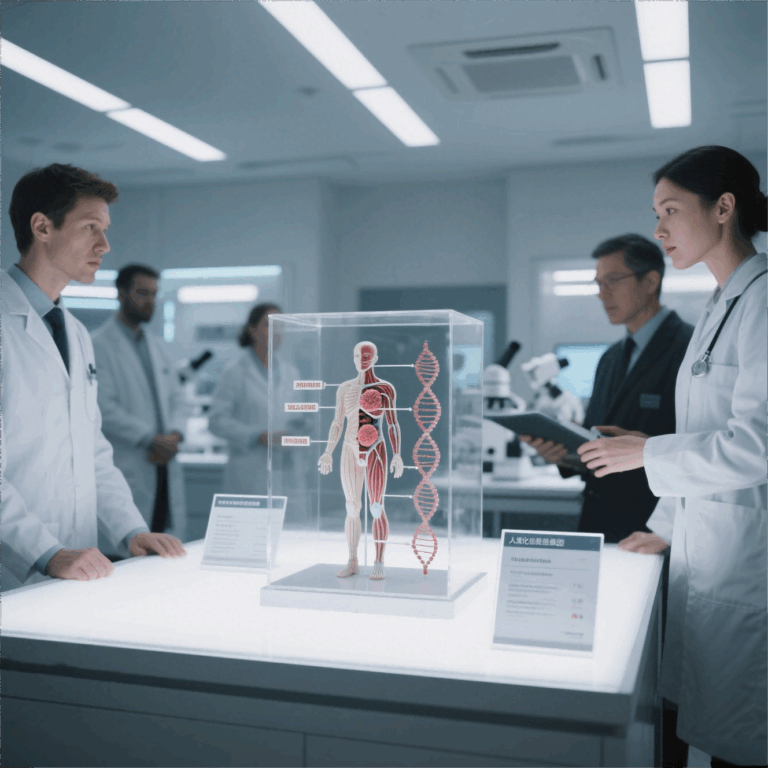
Data-first opening: the gap CDX fills
Preclinical oncology often stumbles not from clever chemistry but from model variability that skews outcomes; a data-first fix is overdue. Industry audits and high-profile reproducibility reviews have pushed labs to tighten standards, and some centers such as MD Anderson have publicly emphasized rigorous model selection. Jennio answers that call with a calibrated cdx model workflow that prioritizes consistent engraftment and measurable tumor burden. Early results show tighter variance in response curves—so studies are comparable and decisions are cleaner. The approach anchors on transparent protocols and quantitative endpoints to reduce wasted time and budget while preserving biological relevance.
Where reproducibility breaks down
Common failures trace to vague sourcing, inconsistent implantation, and poorly tracked readouts. Xenograft experiments are sensitive: cell line passage number, implantation site (orthotopic versus subcutaneous), and monitoring cadence each alter outcomes. Labs often under-report engraftment rate thresholds or skip rigorous randomization, and that produces noisy data that can’t be trusted downstream. Fixing this requires measurable controls and an audit trail—no opinion, just metrics.
Jennio’s CDX design: concrete controls, not buzz
Jennio builds CDX protocols around three pillars: standardized cell handling, defined engraftment criteria, and automated, blinded measurements. Standardized handling reduces variability in cell viability and passage-related drift. Defined engraftment criteria—explicit tumor volume windows and time-to-engraft benchmarks—prevent cherry-picking. Automated imaging and blinded scoring cut observer bias and create reproducible tumor burden curves. This is not theoretical: labs switching to these controls report more consistent dose–response relationships and fewer ambiguous endpoints.
Operational production teardown
Here’s a practical teardown of how a study runs under Jennio’s regimen. First, procurement and authentication steps are logged with timestamps and lot IDs. Next, implantation follows a strict SOP that specifies cell concentration, injection volume, and orthotopic coordinates where applicable. Monitoring uses pre-set imaging intervals and objective tumor volume thresholds for inclusion. The operational checklist tracks engraftment rate, animal welfare parameters, and assay timepoints so every dataset carries provenance. In this section we also incorporate {main_keyword} and {variation_keyword} into metadata fields to ensure searchable, auditable records—so analytical teams can filter by those tags during review.
Common mistakes teams still make
Even with a strong platform, teams stumble on a few predictable points:
– Overlooking passage number as a covariate, which shifts tumor biology subtly but materially.
– Allowing inconsistent endpoint windows that inflate variance and obscure treatment effects.
– Relying exclusively on one readout; multimodal measures (imaging plus biomarker) provide stronger evidence.
—A short aside: trimming one unnecessary variable often clarifies an entire dataset.
Comparative insight: alternatives and trade-offs
PDX models deliver patient relevance but come with higher heterogeneity and cost. Orthotopic xenografts mimic tumor microenvironment better than subcutaneous models but require more technical skill. Jennio positions CDX as a middle ground: higher throughput than PDX, more control than non-standardized xenografts, and a practical path to robust pharmacology signals. Teams should match model choice to the question at hand—target validation, lead optimization, or biomarker discovery—rather than defaulting to a single favored system.
Advisory close: three golden rules for reliable CDX studies
1) Set hard engraftment and inclusion criteria up front: specify tumor volume windows and a minimum engraftment rate to avoid post-hoc selection bias.
2) Lock down provenance: log cell line authentication, passage number, and exact implantation parameters to sustain reproducibility across cohorts.
3) Use orthogonal readouts: combine tumor burden imaging with at least one molecular or histological endpoint to confirm biological effect.
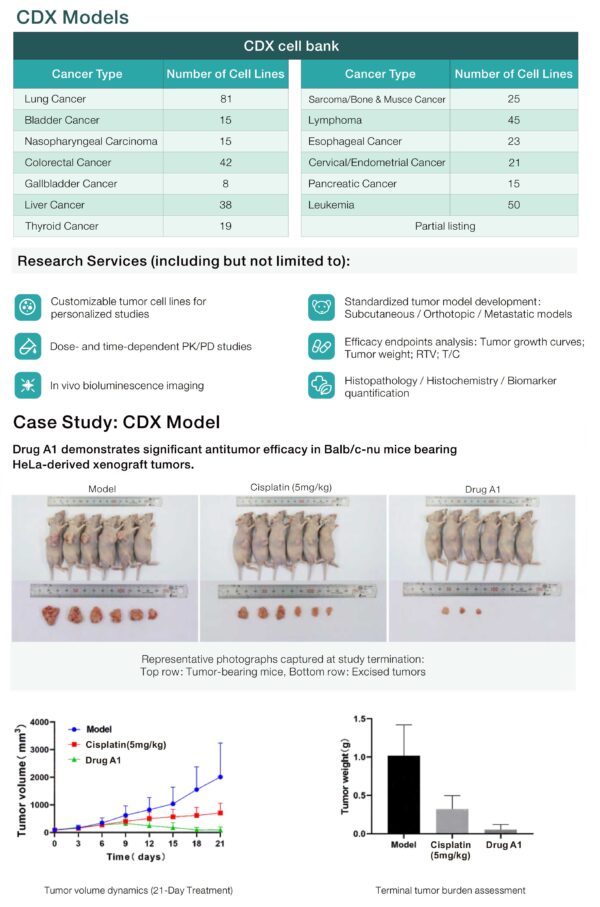
Jennio Biotech brings the discipline and tooling labs need to make preclinical signals trustworthy—simple, measurable design choices that change outcomes. –
