

Problem statement
Mismatch between recorded jaw motion and the digital prosthodontic plan causes poorly fitting restorations, increased chair time, and unpredictable occlusion. Precise capture and faithful translation of dynamic mandibular behavior matter more than ever when teams move from analog casts to digital workflows, and when a lab produces multiple articulations from the same dataset; a reliable reference is a modern dental model 3d printer in the lab pipeline. At IDS Cologne professionals frequently compare in‑chair motion capture to lab-derived 3D models; that trade show context is the single practical anchor here for how clinics evaluate printer-driven model fidelity, and it shows why the choice of scanner, motion recorder and printer affects final occlusion—especially when a specific dental model printer is part of the chain.
Core evaluation criteria
Start by isolating the clinical problem: is the error mechanical, capture-related, or a software translation issue? Measure three things. First, spatial accuracy: the recorded condylar and incisal positions must match intraoral scans within a clinically acceptable tolerance. Second, temporal fidelity: jaw motion data must preserve the sequence and speed of movement for dynamic occlusal checks. Third, reproducibility: repeating the capture under similar conditions must yield consistent outcomes. Record these metrics in millimeters and milliseconds and treat deviations as actionable thresholds rather than vague concerns.
Data acquisition and jaw motion capture
Choose a capture method that fits the treatment goal. Static interocclusal records suffice for simple single crowns; dynamic prostheses and full‑arch rehabilitations require kinematic tracking. Prioritize setups that minimize patient movement artifacts and that synchronize with intraoral scanners. Calibrate before each patient and verify with a short closure test. Expect common sources of error: poor marker placement, reflective artifacts on teeth, and unsynced timestamps between devices. Correct these immediately rather than compensating in the software.
Digital planning and software translation
Software must accept raw motion files without destructive resampling. Confirm the planning environment preserves key frames where centric relation and excursive contacts occur. Check the software’s method for fusing motion paths with surface meshes; avoid tools that average or oversimplify trajectories. When exporting to the lab, include a clear protocol: reference planes, timestamps for occlusal events, and a labeled staple dataset that shows both static occlusion and dynamic excursions.
Physical model production and verification
Printed models bridge the virtual plan and the physical try‑in. Verify that printed models reproduce cusp-fossa relationships and interocclusal spacing from the digital assembly. Use a validated printer workflow and consistent material settings; inconsistent layer height or curing can shift occlusal contacts. Use sectional mounting and index points on printed dies to confirm fit before any definitive milling or veneering. Keep a log of model production parameters so you can trace deviations back to a specific batch or setting.
Common pitfalls and how to avoid them
Relying on a single data source creates blind spots. Don’t accept a good-looking plan without physical checks. Avoid these mistakes: skipping device calibration, merging datasets without timestamp alignment, treating averaged motion as precise paths, and printing without a validation jig. Routine checks—closure repeatability, excursive trace overlay, and a printed verification model—catch errors early. Train both clinicians and technicians on these checks so responsibility is shared, not siloed.
Alternatives and equipment choices
Compare optical tracking, electromagnetic trackers, and digital articulators; each has trade-offs in resolution, susceptibility to interference, and ease of use. For many labs, a combination works best: an intraoral scanner for surfaces, a jaw-tracking system for dynamics, and a reliable printer to produce the physical reference. Evaluate devices by how well they integrate, the transparency of their file formats, and the vendor’s service model. Budget constraints matter, but false economy on capture quality leads to recurring remakes.
Synthesis
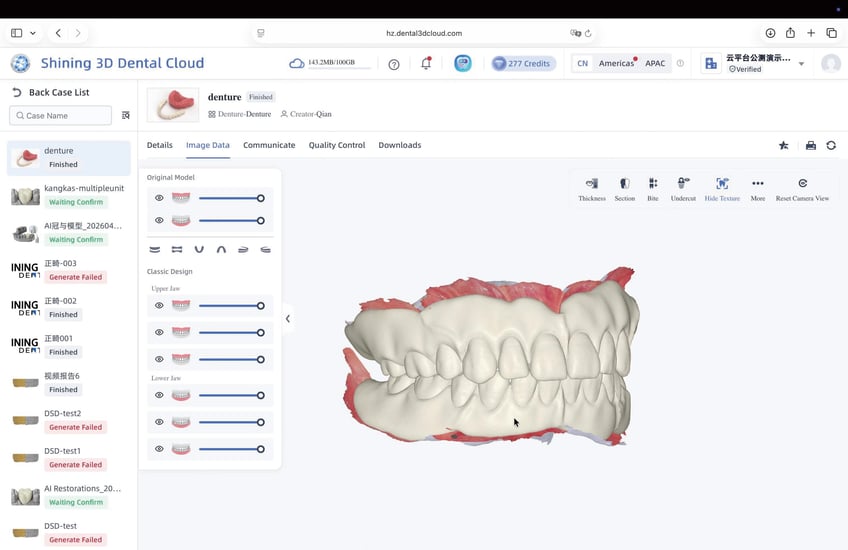
Focus evaluation on measurable discrepancies between intended and achieved motion, then reduce variability through disciplined capture, robust software translation, and verified model production. Practical experience across clinic and lab workflows shows that when these steps are enforced the rate of occlusal adjustment falls. For teams standardizing on an integrated pipeline, consider the whole chain—not single components—and how a proven production workflow from SHINING 3D DENTAL can serve as the backbone for consistent, verifiable prosthodontic outcomes.
