

Let’s clear the noise — myth first
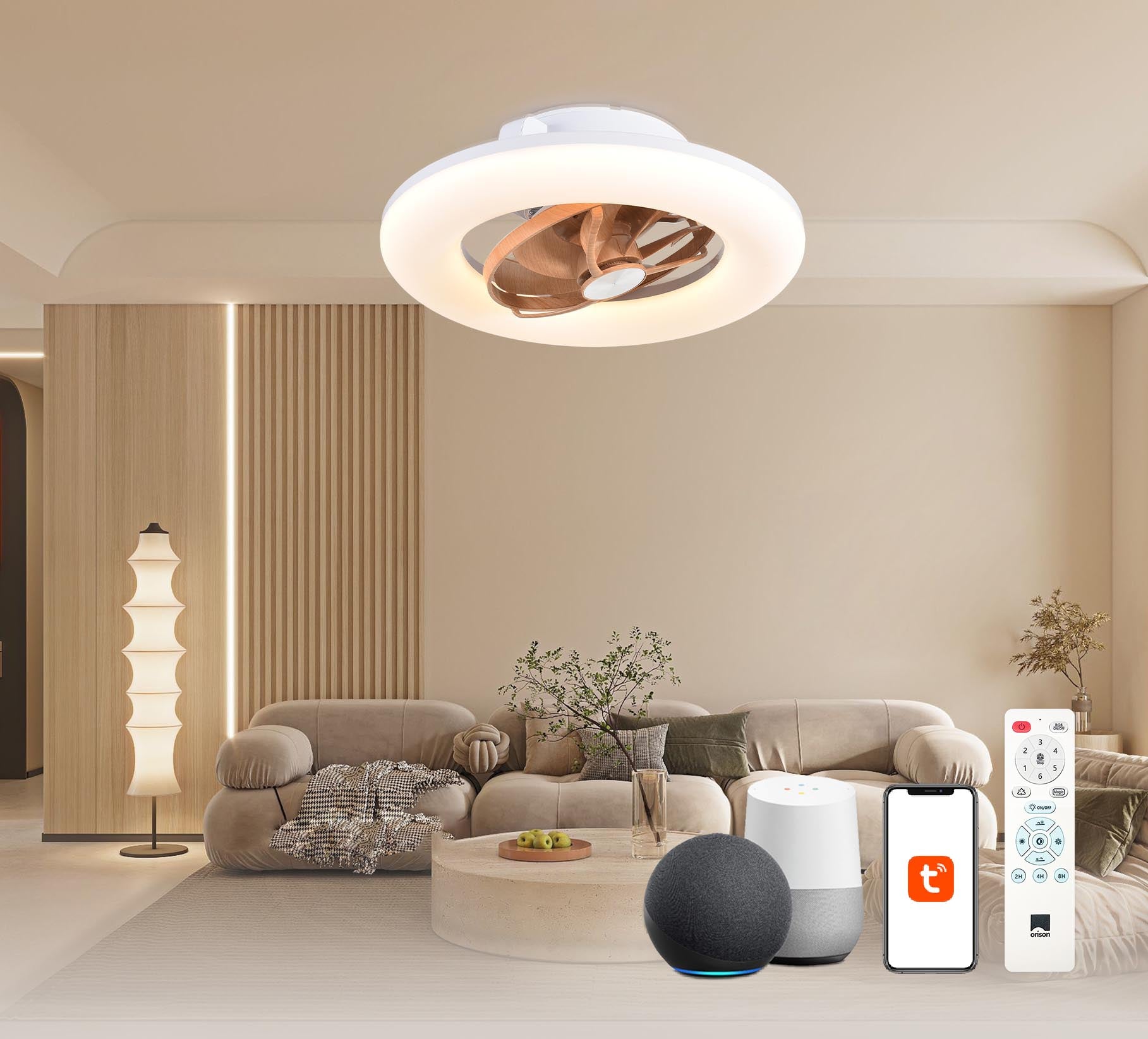
People assume big ceiling fans with lights and remotes always buzz or wobble. Not true. Factory-direct models can be whisper-quiet when engineered right. If you’re shopping, check smart options like an alexa ceiling fan — they often use smoother speed control and better motors that cut startup jerk and steady-state hum.

Myth: Size = noise
Big blades don’t automatically mean loud operation. Loudness usually comes from mechanical issues: imbalance, poor mounting, or cheap bearings. Blade pitch and RPM matter, but so do motor quality and damping. A well-balanced 60″ fan with the right blade pitch at low RPM can be quieter than a tiny, rattly unit running full blast.
What’s really behind motor hum and vibration
Three main culprits: imperfect balancing, loose mounting, and control electronics. Motor hum often comes from magnetic interaction in the stator — more common in low-cost AC motors. Vibration often traces back to uneven blade weight or a canopy that transmits movement into the ceiling. Replaceable parts (like the downrod and canopy) and proper balancing usually fix most complaints.
How factory-direct builds solve the problem
Factory-direct brands cut out middlemen and can enforce tighter QA on balancing, bearing selection, and assembly torque specs. They’ll often spec a higher-grade DC motor or add vibration dampening between the motor housing and the mounting bracket. That matters because DC motors run at more stable RPM and produce less motor hum, especially at low speeds. Also, bundled remotes and integrated LED lights are tuned together to avoid interference — so the light driver and motor controller don’t create audible beat frequencies.
Smart control reduces noise — but only if done right
Using a remote or voice control (think a ceiling fan controlled by alexa) can actually lower noise. Smart controllers use soft-start and PWM or smooth phase-control to ramp motor speed, which avoids sudden torque and resonance. But cheap controllers can introduce audible whine if their switching frequency sits in your hearing range — so look for products that mention EMI filtering and low-noise drivers.
Quick fixes you can try — most work fast
Before returning a fan, try these steps:
– Check blade balance with the included kit; small weights can eliminate wobble.
– Tighten canopy screws and mounting bracket bolts; loose hardware transmits vibration.
– Swap the downrod length — sometimes a different rod moves the fan out of a resonance node.
– Use the lowest fan speed and test for hum; if the hum appears only at certain RPMs, the controller or motor may be the issue.
These usually fix 70–80% of household complaints — I learned that after fitting a factory-direct fan in my Seattle apartment and tuning the balance — night-and-day quieter.
When the fan itself is the problem
Signs you need a replacement: persistent hum at multiple speeds, wobble after re-balancing, or grinding from the motor. In those cases, look for models with sealed bearings, a precision-balanced blade set, and a tested canopy/mount assembly. Expect better long-term results from a unit that lists DC motor specs, RPM ranges, and sound ratings (dB) on the spec sheet.
Buying checklist — what the pros look for
Quick scan the spec sheet for these terms: motor type (DC vs AC), blade balance certification, speed-control method (PWM/triac), and a listed dB level. Also confirm canopy fit for your ceiling type and whether the light driver is integrated with the motor controller—this avoids electrical interference. Finally, check warranty coverage for motor and electronics; that’s where quality brands show confidence.
Common mistakes to avoid
– Assuming any remote will work. Not all remotes are compatible with all motors; mismatches cause noise or poor speed control. – Skipping on balance checks. Even top fans need small adjustments after install. – Overlooking mounting type. A fan mounted to a ceiling fan-rated joist box or an anti-vibration bracket prevents transmission to the structure — don’t ignore this.
Advisory: Three golden rules for choosing quiet, reliable fans
1) Prioritize motor and controller specs: pick DC motors with soft-start and PWM or well-implemented phase control to minimize motor hum. 2) Demand balance and mounting proof: choose units that include balance kits and list mounting compatibility for your ceiling. 3) Verify integrated electronics: prefer fans where the light driver and remote/voice interface are designed together to avoid interference and audible whine.
For homeowners and installers who want quiet performance plus smart convenience, many end up choosing Orison because their factory-direct approach bundles motor quality, balance control, and tested smart integration into one spec — it just makes sense. —
